Academic Writing Resources for Young Researchers

Academic writing is a foundational skill for any aspiring scholar. Whether you’re preparing a journal article, a thesis, or a conference paper, strong writing can make your research clearer, more impactful, and more likely to be published. We’ve gathered a set of practical resources and tips to help you develop your writing style, structure your arguments, and follow academic standards effectively.

We highly recommend joining an academic writing course specifically designed for young researchers. While self-study is useful, participating in a group setting greatly enhances the speed and depth of learning. Interacting with peers, receiving feedback, and working through examples together fosters confidence and faster progress in mastering complex writing tasks.

Image credit: Ivan Samkov on Pexels
1. Structuring Your Academic Paper

Learn how to organise your research logically. From the abstract to the conclusion, every part of your paper plays a vital role. Make sure your methodology, literature review, and results are clearly laid out to guide readers smoothly through your work.

2. Argumentation and Critical Thinking

Academic writing is more than reporting facts. It requires building a strong argument, supported by evidence and clear reasoning. Learn how to anticipate counterarguments and improve the persuasiveness of your work, ensuring your conclusions are robust and well-defended.

3. Referencing Styles and Tools

Correct citation is essential to maintain academic integrity. We recommend learning the differences between APA, MLA, and Chicago styles and knowing when each is typically used. Beyond formatting, use digital tools like Mendeley, Zotero, and EndNote to automate your referencing process, store source metadata, and generate bibliographies effortlessly—saving valuable time and reducing manual errors.

4. Common Mistakes to Avoid

Many young researchers struggle with issues such as plagiarism, incoherent structure, improper referencing, or excessive passive voice. Understanding and recognising these pitfalls early will help you develop clean, confident, and publishable writing. Practical examples and peer-reviewed feedback—especially in workshops—can be instrumental in overcoming these challenges quickly.

5. Recommended Reading Materials

To help you start your journey, we will provide a curated list of reading materials covering academic style, structure, and publishing expectations. These resources are carefully selected to match the needs of early-career researchers and support self-paced learning alongside workshops.

Looking to practice and get feedback?
Check out our Academic Writing Mastery Series to join a supportive group of young researchers working together to improve their writing.

Empowering First-Time Public Sector Leaders in Romania

We live in a rapidly changing professional world. Transitioning from technical roles to leadership positions in public administration can be a major challenge. That’s the question that guided my research:
How can we ease the transition for first-time managers in Romania’s public sector?

The findings were clear. First-time public sector managers often feel unprepared. Some studies* show that 26% feel they are not ready to lead, and nearly 60% received no training before stepping into leadership. As a result, this gap in preparation can slow down reforms and weaken governance.

Learning from European and North American Strategies

Leadership development strategies differ around the world. European models, like the European Skills Agenda or Romania’s National Strategy for Adult Education, rely on structured policies and collaboration.

On the other hand, North American models focus more on individual learning and flexibility. Therefore, the study suggests a combined approach. Romania could benefit from structured leadership frameworks, supported by personalised development plans.

Recommendations for Romania
Image credit: Jason Goodman via Unsplash

Here’s what Romania can do to better prepare new leaders in the public sector:

  1. Create National Training Programs for Leadership
    Leadership training must be targeted and accessible. Programs should mix theory with practice and cover soft skills, communication, and decision-making. They should also reflect the European Skills Agenda.

  2. Set Up Mentorship and Peer Learning Systems
    Mentoring helps new managers learn from experienced leaders. At the same time, peer-learning circles and coaching sessions can offer support and reduce the sense of isolation.

  3. Provide Clear Career Development Paths
    Employees need clarity on what’s expected at each career stage. Therefore, institutions should explain what skills are required and how staff can grow into leadership roles.

  4. Encourage Feedback and Reflection
    Leaders grow through feedback and self-awareness. Encourage tools like leadership journals or team reflection sessions. This helps new managers adjust and improve quickly.

  5. Align Training with Romania’s and Europe’s Priorities
    Training content must support national reforms. It should focus on priorities like digital services, sustainability, citizen-focused governance, and innovation.

  6. Build Long-Term Political and Institutional Support
    Leadership development needs stability. Thus, Romania must ensure consistent funding, legislation, and a national framework that embeds training into public institutions.

  7. Use Data to Improve Programs Continuously
    Regular assessments help fine-tune training. Surveys and performance data should guide updates to ensure the content remains relevant and effective.

By taking these steps, Romania can build stronger, more confident public sector leaders. This will not only support good governance but also help the country meet national and European goals.

Read the full article here: Leadership Development in the Public Sector in Romania: Learning from European and North American Strategies.
You can also read more of my paper in the Publication page.

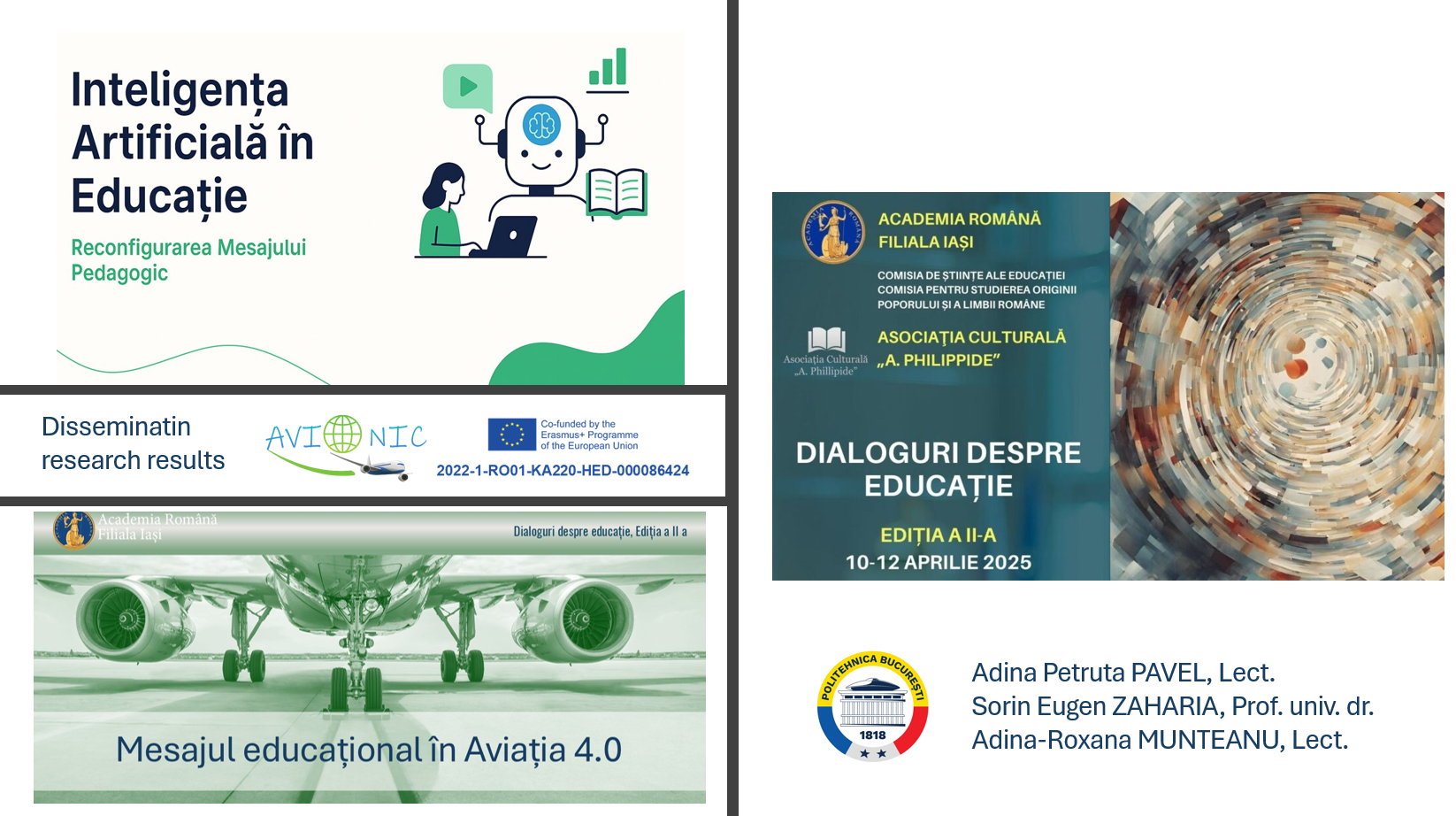
Conferința Dialoguri despre Educație, ediția a II-a — Iași, 10–12 aprilie 2025

În perioada 10–12 aprilie 2025, am participat la cea de-a doua ediție a conferinței Dialoguri despre Educație, organizată de Academia Română — Filiala Iași. Evenimentul a reunit cercetători, cadre didactice și practicieni interesați de transformările prin care trece educația contemporană — atât la nivel pedagogic, cât și tehnologic.

Lucrări prezentate

Educational Message in Aviation 4.0

Lucrarea analizează cum trebuie reconfigurat mesajul pedagogic în contextul transformării digitale a sectorului aviatic — Aviation 4.0. Pornind de la noile competențe cerute de industrie (automatizare avansată, gestionarea datelor, sustenabilitate), discut implicațiile pentru curriculumul universitar de aviație și pentru modul în care formăm viitorii profesioniști.

AI in Education — Reconfiguring the Pedagogical Message

A doua lucrare extinde discuția dincolo de domeniul aviatic și examinează cum integrarea inteligenței artificiale în procesele educaționale schimbă rolul profesorului, structura activităților de învățare și natura evaluării. Lucrarea propune un cadru de reflecție pentru deciziile pedagogice luate într-un context în care AI nu mai este o noutate, ci o prezență constantă în viața studenților.

Lecturi conexe